
It is with great sadness that I fell into the RISC-V craze. One may even
say that I had great enthusiasm for this "OPEN" architecture type idea.
In the Beginning
A few decades ago I was seated in front of an APOLLO DN1000 workstation
and it was running some variant of BSD UNIX™ as well as a snazzy
graphical front end. All of that was actually coming from a remote unit
over the network. This was not batch processing with the HoneyWell CP6
mainframe and there were no punch cards to be seen. Life was good. Next
there was the powerful DN10000 unit and it was a real screamer. Amazing
performance with just the most fantastic graphics you could desire. Life
was good.
It was only a few years later that I first saw the Sun SPARC machines and
those were also running some variant of BSD UNIX™ that we called “SunOS”.
We could code and run and do all manner of cool stuff without the need of
the mainframes at all. There was much gnashing of teeth and wailing by the
mainframe crew. My days of FORTRAN77 seem to be behind me. Well, not really.
Those Sun machines could really crank the math and life was good.
I was only barely aware that the processor architecture in these machines
was called "R I S C". This means Reduced Instruction Set Computer where a
system could perform a reasonable instruction within a single clock cycle.
At least that was the theory and to some extent it seemed as if these were
the most effective machines around. Thanks to the ideas of John Hennessy and
David Patterson we were able to get ever more impressive benchmark results
out of these new snazzy RISC machines. In many cases they would run circles
around the local mainframe machines. Need I say it? Life was good.
------------------------------------------------------------------
a paragraph is needed in here ... some sort of a decades long rant
------------------------------------------------------------------
When the SiFive people came along with the first reasonable RISC-V chips
it seemed as if we may get that fantastic evolution going once again. We
may once again get the unicorn dancing with fast, cheap and efficient all
at the same time. On a rainbow. So I jumped at the chance to accept the
"Freedom" of an open architecture RISC-V device. This was followed almost
right away by sadness and harsh reality. Sure, you may say, the specs were
pretty and the names in the published documentation were very impressive.
There we see David Patterson all over the place. This idea of a RISC-V
“Foundation” was interesting to say the least. It may even be a real thing.
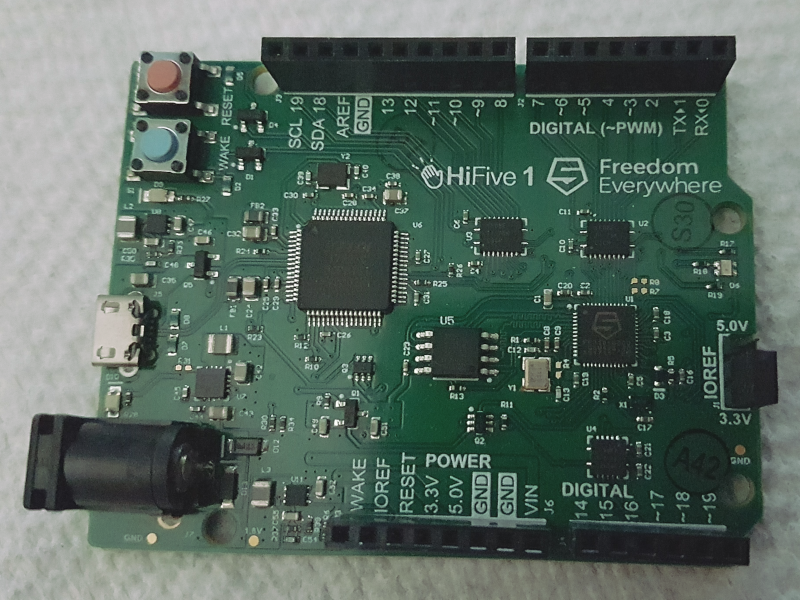
I managed to get that incredible freedom to blink an led a few times. Then
it went right back into the cardboard box it shipped in. Never moved again
until I took a photo today. Then back into the box. Freedom. I can feel it.
The Power of UnMatched RISC-V
Somewhere about 2021 or maybe 2022 there was a whole new snazzy RISC-V board
announced by the SiFive people. It was to be actually useful as a workstation
wherein Linux desktop was possible? Really. We shall see about that. I just
had to get one of those.
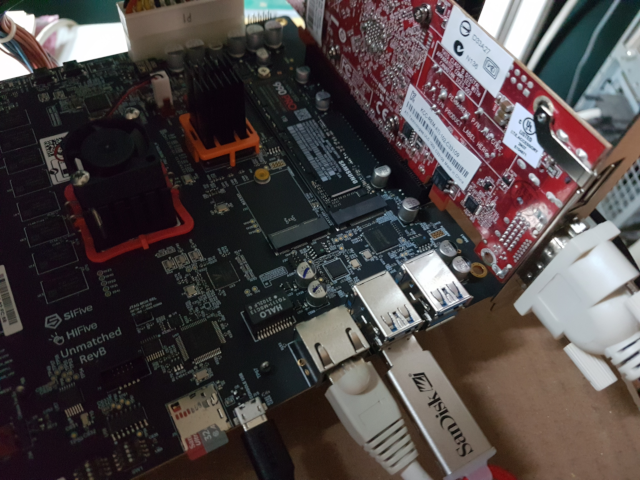
It was a total nightmare to get this thing running anything useful. With the
help of some really talented people I was able to install FreeBSD. The process
took at least a week of work. I am happy to say that it is still running today.
Very slowly. So slow in fact that the Samsung 990 PRO SSD on the board was a pure
waste of money. I was not sure what to do with the thing. It took about four or
five days to compile the FreeBSD sources. Getting RUST as a workable package is
another four to six days. Just horrific performance. However it is, as one may
say, the real thing. Indeed it is.
I had to try a few old tricks. Way back when there was a cool magazine called
Scientific American and in that cool thing was a section for cool math things.
Martin Gardner. Need I say more?
Those of you that know .... you know. You know. Yes you do.
How about a trivial old test? Something we may do with a seven digit calculator
back in 1984. Take a trivial number like one. You know ... one. Just one. Then
push the precision out a bit and go to 1. 000 000 1 with six zeros. Here we are
ready to enter what I call the Fred Gruenberger loop. Square that number. Easy.
However you will quickly see that computers are very very bad at handling this
task. Computers will need to handle thousands of digits. Why would you want to?
Here we need to see Scientific American, Vol. 250, No. 4 (April 1984), pp. 19-27
therein you will be caught by this trivial problem :
If you have a calculator with a key for squaring a number, try
this: enter the number 1.0000001 and press the square key 27 times.
The procedure is equivalent to raising the initial number to
the 134,217,728th power. The correct result, accurate to
10 significant digits, is 674,530.4707
I assure you that this was a mind wrecker back in the mid of 1985. We had
FORTRAN77 and APL with some mainframes. None of those could process anything
like this. We lined up for our copies of SciAm and we stared at our punch
cards. How do we make an array of digits in memory and then process such
a trivial problem? Thankfully the issue is addressed by the cool folks that
wrote what I call “The Book”. Please get your copy of the book that is
“Handbook of Floating-Point Arithmetic”, second edition and written with
love. Crack that open and you see Jen-Michel Muller whom you should all
know. Also a great man named Vincent. Endless work has poured into this
text wherein we learn that computers DO NOT MATH. How can any RISC machine
save us? Good luck. get your floating wood and tell Jack you love him.
Hold on. Hold on. We have libMPFR.
I now have a real RISC-V machine and the libMPFR library works like a
charm. Therefore we can take an old problem and actually compute every
single last digit. With total precision. The dream of 1984 can be made
real in 2024 with a tiny little RISC-V board. Well indeed ... yes.
The question can be taken to pure integers with just 10000001 as the
input. However any computer can do this? Right? Just ask for the damn
number 1 + 1^(-7) as the input and then wreck havok. I do indeed wish
you the best of luck. Have fun.
Have we lost the point? Yeah that RISC-V goodness that is fully open
and full of promise. Yep. That. Sell me that. Twice. Come on and tell
me how sweet you are. Thou art RISC-V. The real RV64imafdc damn it! The
real thing. Guess what. Yes the SiFive UnMatched RevB is that. All of it.
Right ... watch this .. ha ha .. lets crank out ye old Mandelbrot also!
123456789+123456789+123456789+123456789+123456789+123456789+123456789+12
Nice thing about the RISC-V architecture is that we get valid 64-bit data
types from the IEEE-754 spec. You know that right? Seems that just about any
calculator made in the last five decades can square 1.0000001 and give a result.
With no clue what to do I simply nailed it to a wall and
there it is well hung.
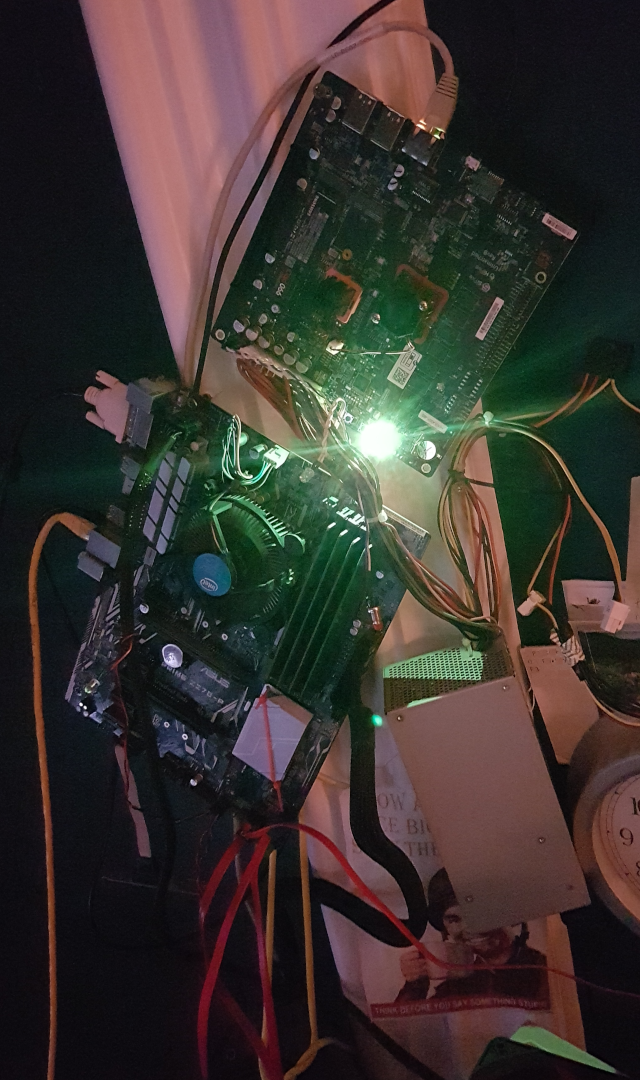
From time to time I do use that SiFive UnMatched RevB board for some testing.
It never fails to surprise me with just how sluggish and snail like it can
be. To say that I was grossly unimpressed would be barely sufficient. It works.
Does stuff. Shut up and be happy it is RISC-V right?
The wow factor of the SiFive P550
Somewhere in the middle of 2024 there were rumours. Muttering. A new and
improved with three new ingredients RISC-V board was in the works. Gluten
free and so very very fast. I was excited. I was enthusiastic. I was just
another RISC-V fan with no damn clue. At the very least I had a beard and
my suspenders. I was ready for the P550.
NOTE : At this point I crack a beer. You would too.
Finger tips hover over that "Order" button. Flip a coin. Flip it again.
Hit it with reckless abandon. This time, surely, everything will work. At
the very least it will be fast enough to use daily. Right? Well here is
is the amazing wonderous SiFive P550 sitting on my desk doing nothing.
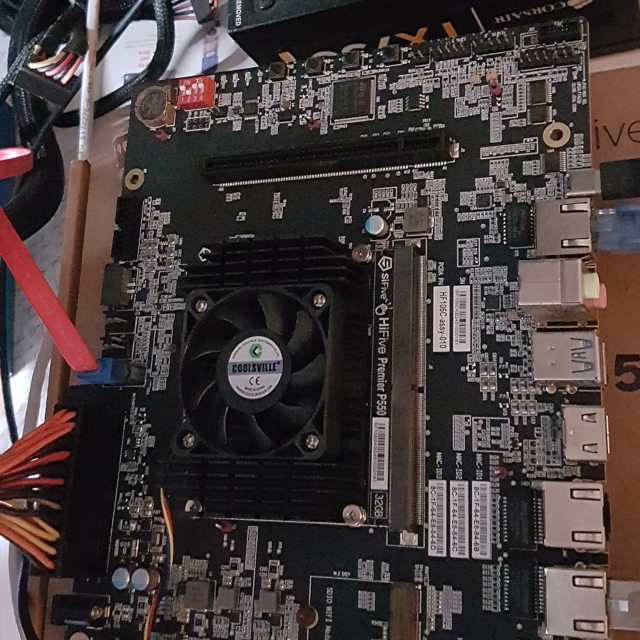
How did things go so wrong so fast? Why is this P550 board dead? Does it
do anything at all? Did it ever?
 Checked as HTML 4.01 Strict
 Validates as CSS level 3 + SVG